

John's theorem states that if  is a compact set
that is convex and has nonempty interior,
and its John ellipsoid is the unit
ball
is a compact set
that is convex and has nonempty interior,
and its John ellipsoid is the unit
ball  ,
then there are contact points
,
then there are contact points  and positive numbers
 such that
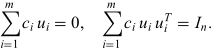 |
Conversely, the existence of such points and numbers characterizes  as the unique maximum-volume ellipsoid contained in
  . Here
  is the
  identity matrix,
and at most
identity matrix,
and at most  contact points are needed (John 1948, Henk 2012).
The theorem also gives
 |
If  is a centrosymmetric
set, the factor
is a centrosymmetric
set, the factor  can be replaced by
  ;
both factors are best possible (John 1948, Henk 2012).
;
both factors are best possible (John 1948, Henk 2012).
