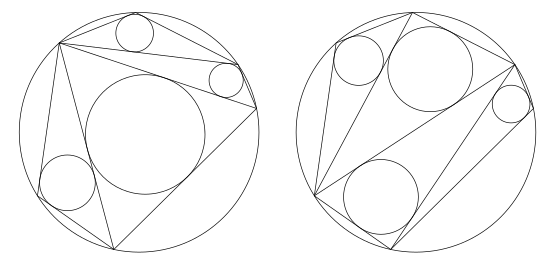
The Japanese theorem states that if a convexcyclic polygon is triangulated in any manner and the
incircle of each triangle
is drawn, then the sum of the inradii is a constant
independent of the triangulation chosen. This theorem
can be proved using Carnot's theorem. In the above
figures, for example, the inradii of the left triangulation
are 0.142479, 0.156972, 0.232307, 0.498525, and the inradii
of the right triangulation are 0.157243, 0.206644, 0.312037, 0.354359, giving a sum
of 1.03028 in each case.
According to an ancient custom of Japanese mathematicians, this theorem was a Sangaku problem inscribed on tablets hung in a Japanese
temple to honor the gods and the author in 1800 (Johnson 1929).