


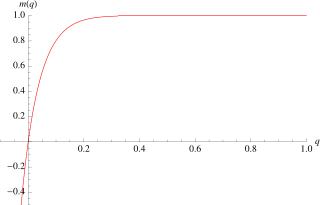
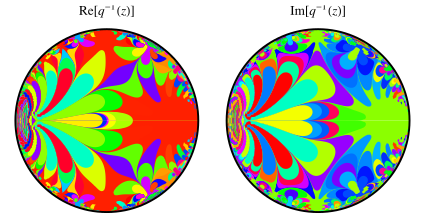
The inverse nome is obtained by solving the nome  for the elliptic parameter
 and is given by
 |  |  |
(1)
|
 |  |  |
(2)
|
for  , where
 is a Jacobi
theta function,
 is the Dedekind eta function, and
 is the nome.
The inverse nome function is essentially the same as the elliptic lambda function, the difference being that the elliptic
lambda function is a function of the half-period
ratio  , while the inverse nome is a function of the nome
 , where
 is itself a function of
 .
The inverse nome is implemented as InverseEllipticNomeQ[q] in the Wolfram Language.
For a real number  with
 , the inverse nome and
nome are mutual inverse
functions. For a general complex number
 with
 , the principal
branch of the nome need not recover the original
 from
 . This reflects the modular
transformations under which the elliptic
lambda function is invariant (NIST 2026, §23.18).
Special values include
 |  |  |
(3)
|
 |  |  |
(4)
|
 |  |  |
(5)
|
where the last row is a limit along the real axis. The series defining the Jacobi
theta functions converge strictly inside the unit
circle, which is a natural boundary with
a dense set of singularities. The last row does not
assign a value at  .
It has series
 |
(6)
|
(OEIS A115977).
It satisfies
 |
(7)
|
