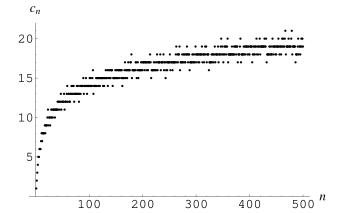
The complexity
of an integer
is the least number of 1s needed to represent it using only additions,
multiplications, and parentheses.
For example, the numbers 1 through 10 can be minimally represented as
(1)
(2)
(3)
(4)
(5)
(6)
(7)
(8)
(9)
(10)
(11)
(12)
(13)
so the complexities for , 2, ..., are 1, 2, 3, 4, 5, 5, 6, 6, 6, 7, 8, 7, 8, ...
(OEIS A005245).
The smallest numbers of complexity , 2, ... are 1, 2, 3, 4, 5, 7, 10, 11, 17, 22, 23, 41, ...
(OEIS A005520).
Guy, R. K. "Some Suspiciously Simple Sequences." Amer. Math. Monthly93, 186-190, 1986.Guy, R. K.
"Monthly Unsolved Problems, 1969-1987." Amer. Math. Monthly94,
961-970, 1987.Guy, R. K. "Unsolved Problems Come of Age."
Amer. Math. Monthly96, 903-909, 1989.Guy, R. K.
"Expressing Numbers Using Just Ones." §F26 in Unsolved
Problems in Number Theory, 2nd ed. New York: Springer-Verlag, p. 263,
1994.Pegg, E. Jr. "Math Games: Integer Complexity." Apr. 12,
2004. https://www.mathpuzzle.com/MAA/17-Integer%20Complexity/mathgames_04_12_04.html. Pegg, E. Jr. "Integer Complexity." https://library.wolfram.com/infocenter/MathSource/5175/.Rawsthorne,
D. A. "How Many 1's Are Needed?" Fib. Quart.27, 14-17,
1989.Sloane, N. J. A. Sequences A005245/M0457
and A005520/M0523 in "The On-Line Encyclopedia
of Integer Sequences."Wolfram, S. A
New Kind of Science. Champaign, IL: Wolfram Media, p. 916,
2002.


 of an integer
  is the least number of 1s needed to represent it using only additions,
multiplications, and parentheses.
For example, the numbers 1 through 10 can be minimally represented as
is the least number of 1s needed to represent it using only additions,
multiplications, and parentheses.
For example, the numbers 1 through 10 can be minimally represented as
























 , 2, ..., are 1, 2, 3, 4, 5, 5, 6, 6, 6, 7, 8, 7, 8, ...
(OEIS A005245).
, 2, ..., are 1, 2, 3, 4, 5, 5, 6, 6, 6, 7, 8, 7, 8, ...
(OEIS A005245).
 , 2, ... are 1, 2, 3, 4, 5, 7, 10, 11, 17, 22, 23, 41, ...
(OEIS A005520).
, 2, ... are 1, 2, 3, 4, 5, 7, 10, 11, 17, 22, 23, 41, ...
(OEIS A005520).

 Pegg, E. Jr. "Integer Complexity."