

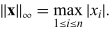
The term infinity norm refers to two closely related norms. For a finite vector  , the infinity norm, also called the maximum
norm, is the L∞-norm
, the infinity norm, also called the maximum
norm, is the L∞-norm
 |
More generally, the L∞-norm of an essentially bounded measurable function  is
is  , where the abbreviation
  denotes the essential
supremum. The finite-vector formula is the special case for a finite
set with counting measure.
denotes the essential
supremum. The finite-vector formula is the special case for a finite
set with counting measure.
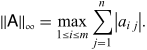
For a matrix, the infinity norm generally means the matrix norm induced by the vector infinity norm. It is the maximum absolute row sum norm,
 |
In finite-dimensional spaces the vector infinity norm is equivalent to every vector norm, although their numerical values differ.
