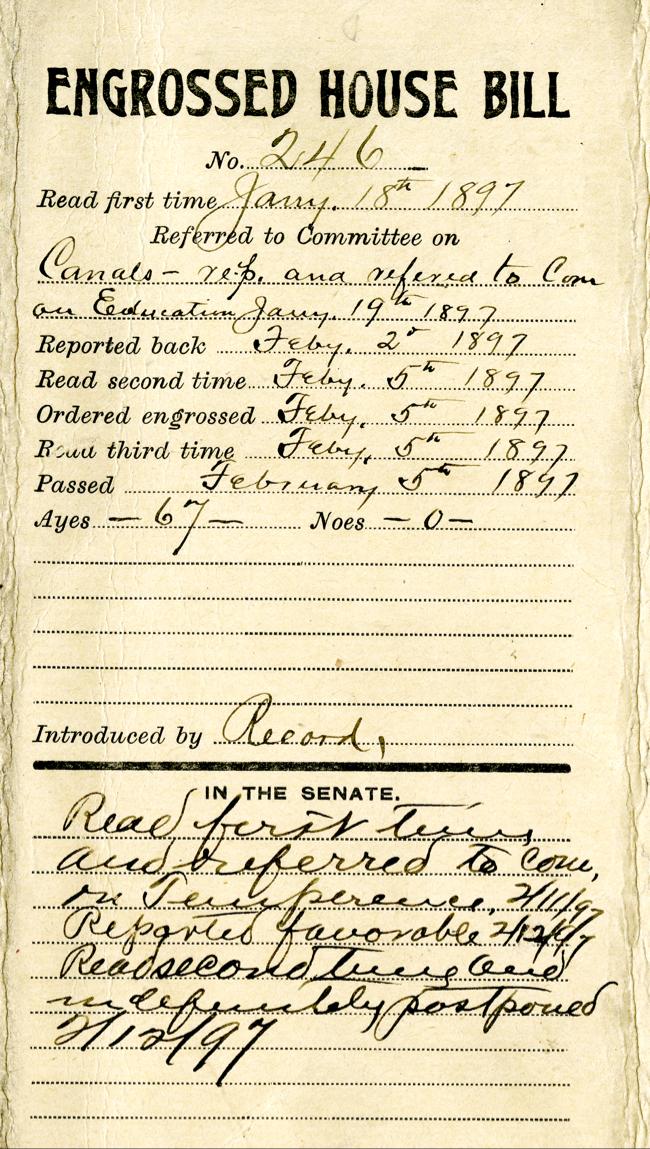
The Indiana pi bill was Indiana House Bill 246 of 1897, introduced on behalf of amateur mathematician Edward J. Goodwin. The bill attempted to grant the state free
use of Goodwin's claimed method of circle squaring.
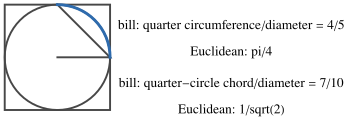
Its geometrical statements are mutually inconsistent; among them are the assertions
that the quarter-circumference of a circle
is four fifths of its diameter and that the chord
of a quarter-circle is seven tenths of its diameter
(Goodwin 1894, Edington 1935).
The first assertion implies
while the second implies
The bill passed the Indiana House, but further action was indefinitely postponed by the Senate after Purdue University mathematician C. A. Waldo explained the errors to legislators (Edington 1935, Beckmann 1993).
Beckmann, P. A History of Pi, 3rd ed. New York: Dorset Press, pp. 174-177, 1993.Edington,
W. E. "House Bill No. 246, Indiana State Legislature, 1897."
Proc. Indiana Acad. Sci.45, 206-210, 1935.Goodwin, E. J.
"Quadrature of the Circle." Amer. Math. Monthly1, 246-248,
1894.History of Mathematics Project. "Indiana Pi Bill." Image:
Indiana State Archives and Records Administration, Indiana General Assembly Collection;
made available by the Indiana State Library. https://www.history-of-mathematics.org/artifacts/indiana-pi-bill.