If
is an odd integer, and and are prime, then is -hyperperfect. McCranie (2000) conjectures that all -hyperperfect numbers for odd are in fact of this form. Similarly, if and are distinct odd primes such that for some integer , then is -hyperperfect. Finally, if and is prime, then if is prime for some < then is -hyperperfect (McCranie 2000).
The first few hyperperfect numbers (excluding perfect numbers) are 21, 301, 325, 697, 1333, ... (OEIS A007592).
If perfect numbers are included, the first few
are 6, 21, 28, 301, 325, 496, ... (OEIS A034897),
whose corresponding values of are 1, 2, 1, 6, 3, 1, 12, ... (OEIS A034898).
The following table gives the first few -hyperperfect numbers for small values of . McCranie (2000) has tabulated all hyperperfect numbers less
than .
Guy, R. K. "Almost Perfect, Quasi-Perfect, Pseudoperfect, Harmonic, Weird, Multiperfect and Hyperperfect Numbers." §B2 in Unsolved
Problems in Number Theory, 2nd ed. New York: Springer-Verlag, pp. 45-53,
1994.McCranie, J. S. "A Study of Hyperperfect Numbers."
J. Integer Sequences3, No. 00.1.3, 2000. https://cs.uwaterloo.ca/journals/JIS/VOL3/mccranie.html.Minoli,
D. "Issues in Nonlinear Hyperperfect Numbers." Math. Comput.34,
639-645, 1980.Roberts, J. The
Lure of the Integers. Washington, DC: Math. Assoc. Amer., p. 177, 1992.Sloane,
N. J. A. Sequences A000396/M4186,
A007592/M5113, A007593/M5121,
A028499, A028500,
A034897, and A034898
in "The On-Line Encyclopedia of Integer Sequences."te Riele,
H. J. J. "Hyperperfect Numbers with Three Different Prime Factors."
Math. Comput.36, 297-298, 1981.


 is called
  -hyperperfect
if
-hyperperfect
if


![1+k[sigma(n)-n-1],](/images/equations/HyperperfectNumber/Inline8.svg)
 is the divisor function and the summation is
over the proper divisors with
is the divisor function and the summation is
over the proper divisors with  . Rearranging gives

 gives the usual perfect numbers.
 is an odd integer, and
  and
and  are prime, then
  is
is  -hyperperfect. McCranie (2000) conjectures that all
  -hyperperfect numbers for odd
  are in fact of this form. Similarly, if
  and
and  are distinct odd primes such that
  for some integer
  , then
  is
is  -hyperperfect. Finally, if
  and
and  is prime, then if
 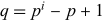 is prime for some
  < then
  is
is  -hyperperfect (McCranie 2000).
 are 1, 2, 1, 6, 3, 1, 12, ... (OEIS A034898).
The following table gives the first few
are 1, 2, 1, 6, 3, 1, 12, ... (OEIS A034898).
The following table gives the first few  -hyperperfect numbers for small values of
  . McCranie (2000) has tabulated all hyperperfect numbers less
than
. McCranie (2000) has tabulated all hyperperfect numbers less
than  .
.

 -hyperperfect number