A holonomic function of one variable, also called a D-finite function, is a local analytic function satisfying a nontrivial linear
homogeneous ordinary differential equation
with polynomial coefficients,
where the  are not all zero. Equivalently, the vector
space over the field
 of rational functions
spanned by
 and all its derivatives is finite-dimensional (Stanley
1980, pp. 175-176). In particular, the defining equation
is an algebraic differential equation.
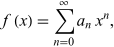
The definition also applies to a formal power series
without assuming convergence. Such a formal power series is holonomic iff its coefficients
form a holonomic sequence (Stanley 1980, pp. 176-177).
Trigonometric polynomials give a class
of holonomic functions with constant coefficients
in their defining ordinary differential
equations.
See also
Algebraic Differential Equation,
Holomorphic Function,
Holonomic
Constant,
Holonomic Rank,
Holonomic
Sequence,
Holonomic System,
Holonomy
Explore with Wolfram|Alpha
References
Koepf, W. Hypergeometric Summation: An Algorithmic Approach to Summation and Special Function Identities.
Braunschweig, Germany: Vieweg, p. 2, 1998.Stanley, R. P. "Differentiably
Finite Power Series." Europ. J. Combin. 1, 175-188, 1980. https://doi.org/10.1016/S0195-6698(80)80051-5.Zeilberger,
D. "A Holonomic Systems Approach to Special Functions Identities." J.
Comput. Appl. Math. 32, 321-368, 1990. https://doi.org/10.1016/0377-0427(90)90042-X.Referenced
on Wolfram|Alpha
Holonomic Function
Cite this as:
Weisstein, Eric W. "Holonomic Function."
From MathWorld--A Wolfram Resource. https://mathworld.wolfram.com/HolonomicFunction.html
Subject classifications