


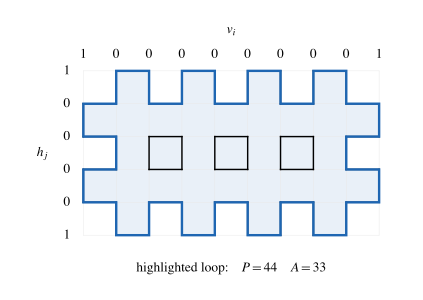
A hitomezashi pattern is an arrangement of horizontal and vertical unit line segments on the integer lattice  , specified by one binary label for each horizontal and vertical
line. Assign labels
 to the horizontal lines
and
 to the vertical lines, where
 and
 range over all integers. Draw
the horizontal line segment from
 to
 iff
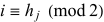 , and draw the vertical line
segment from
 to
 iff
 (Seaton and Hayes 2023, Defant and Kravitz 2024).
The labels specify which of the two alternating sets of unit line
segments is used on each line (Numberphile 2021).
Exactly one horizontal and one vertical line segment meet at every lattice point. Following the line segments therefore gives either a closed curve or a curve extending infinitely in both directions, turning through a right angle at every lattice point. A finite rectangular crop can also contain stitch chains ending at its boundary.
A closed hitomezashi loop bounds a simple polygon. Its perimeter  , measured in unit stitches, satisfies
 |
and its enclosed area  , measured in unit squares, satisfies
 |
These congruences hold for every loop, independently of how the binary labels are chosen (Defant and Kravitz 2024).
