

Hilbert's Nullstellensatz states that if  is an algebraically closed
field and
is an algebraically closed
field and  is an ideal of the polynomial
ring
is an ideal of the polynomial
ring ![K[x_1,...,x_n]](/images/equations/HilbertsNullstellensatz/Inline3.svg) ,
then the set
,
then the set  of points
  satisfying
  for every
  determines the ideal radical of
  by
by
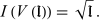 |
Here  is the ideal of all polynomials that vanish on
  . Equivalently, if a polynomial
  vanishes at every common zero of
  , then
  for some positive integer
  . The weak Nullstellensatz says that every proper
ideal of
. The weak Nullstellensatz says that every proper
ideal of ![K[x_1,...,x_n]](/images/equations/HilbertsNullstellensatz/Inline15.svg) has a common zero in
has a common zero in  .
.
