


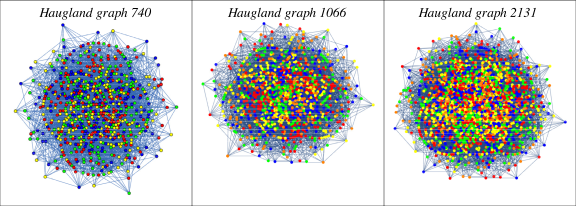
The Haugland graphs are the three unit-distance graphs  ,
,
 , and
, and  used by Haugland (2026) in the construction of a Moser
spindle-free graph with chromatic number
5.
used by Haugland (2026) in the construction of a Moser
spindle-free graph with chromatic number
5.
| graph | vertex count | edge count | role |
 | 740 | 3985 | initial graph |
 | 1066 | 6264 | intermediate graph |
 | 2131 | 12530 | final 5-chromatic graph |
The vertices of  are exact partial sums along
231 polygonal paths whose steps are selected from 84 directed
unit vectors obtained from a 21-vertex unit-distance graph with sevenfold rotational
symmetry. Exact rotations and translations
of two copies of
are exact partial sums along
231 polygonal paths whose steps are selected from 84 directed
unit vectors obtained from a 21-vertex unit-distance graph with sevenfold rotational
symmetry. Exact rotations and translations
of two copies of  produce
  .
An exact rotation and translation
of a second copy of
.
An exact rotation and translation
of a second copy of  ,
together with the original, produces
,
together with the original, produces  .
.
The three graphs will be implemented in a future version of the Wolfram Language as GraphData["HauglandGraph740"], GraphData["HauglandGraph1066"], and GraphData["HauglandGraph2131"], respectively.
All three graphs are unit-distance graphs realized in the Euclidean plane, but are nonplanar
graphs. The final graph  has chromatic number
5 and contains no Moser spindle (Haugland 2026).
It is the smallest known unit-distance graph
with chromatic number 5 subject to the latter
restriction, while the smallest known without that restriction remains the 509-vertex Parts graph.
has chromatic number
5 and contains no Moser spindle (Haugland 2026).
It is the smallest known unit-distance graph
with chromatic number 5 subject to the latter
restriction, while the smallest known without that restriction remains the 509-vertex Parts graph.
