


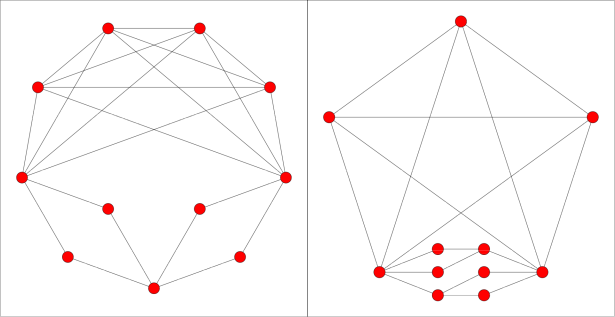
The Harvey-Royle graphs are the two graphs on 11 vertices illustrated above. The first has 22 edges and chromatic number 5, while the second has 19 edges and chromatic number 4. The first and second Harvey-Royle graphs have graph crossing number 3 and 1, respectively.
Their chromatic polynomials have  as a chromatic root,
where
 is a Beraha constant and
 is the golden ratio. They
supplied the first examples of graphs having
 as a chromatic root.
Since every other noninteger Beraha constant
had already been ruled out as a chromatic root,
the examples resolved a question of Salas and Sokal (2001) and completed the determination
of which Beraha constants can be chromatic
roots (Harvey and Royle 2020).
The Harvey-Royle graphs are implemented in the Wolfram Language as GraphData["HarveyRoyleGraph1"] and GraphData["HarveyRoyleGraph2"].

 ." J. Graph Theory 95, 445-456, 2020.