

The happy edge conjecture asserted that any two plane spanning trees on the same point set admit a shortest flip sequence preserving every graph edge common to both. Such a shared graph edge is called a happy edge. A flip replaces one graph edge with another while keeping the spanning tree plane. The flip distance is measured in the plane spanning tree flip graph (Aichholzer et al. 2024, 2026).
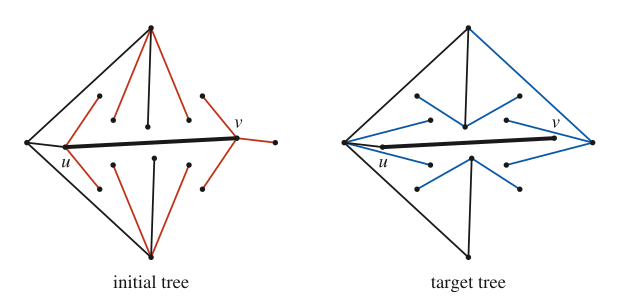
Aichholzer et al. (2026) disproved the conjecture with two constructions. The figure redraws their Figure 2, showing two plane spanning
trees on 16 points in general
position. Their six shared edges are black, with
 drawn thicker. Every shortest sequence takes 12 flips and temporarily removes
 . Preserving all shared edges
takes 13 flips. Removing
 allows two temporary edges
to serve four pairs of leaves, saving two insertions
at the cost of one flip to restore
 . On the second point
set, consisting of 30 points in convex position, the
corresponding minima are 19 and 20. The authors report discovering the two counterexamples
with Claude Opus 5.5.
A compatible flip requires the interiors of the deleted and inserted line segments to be disjoint. A rotation is a compatible
flip in which the two edges share an endpoint. An edge
slide rotates  to
 along an existing graph edge
 through an empty triangle
 (Aichholzer and Reinhardt 2007, Aichholzer
et al. 2024, 2025). The happy edge property fails for unrestricted flips,
rotations, and edge slides on point sets in either convex
or general position. It also fails for compatible
flips in general position, as the 16-point counterexample shows. On convex point
sets, every shortest compatible flip sequence preserves all happy edges
(Aichholzer et al. 2025, 2026).
