


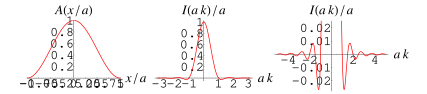
The Hanning function is an apodization function, also called the Hann function, frequently used to reduce leakage in discrete Fourier transforms. The illustrations above show the Hanning function, its instrument function, and a blowup of the instrument function sidelobes. It is named after the Austrian meteorologist Julius von Hann (Blackman and Tukey 1959, pp. 98-99). The Hanning function is given by
 |  |  |
(1)
|
 |  | ![1/2[1+cos((pix)/a)].](/images/equations/HanningFunction/Inline6.svg) |
(2)
|
Its full width at half maximum is  .
.
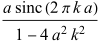
It has instrument function
 |  |  |
(3)
|
 |  | ![a[sinc(2pika)+1/2sinc(2pika-pi)+1/2sinc(2pika+pi)].](/images/equations/HanningFunction/Inline13.svg) |
(4)
|
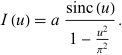
To investigate the instrument function, define the dimensionless parameter  and rewrite the instrument function as
 |
(5)
|
The half-maximum can then be seen to occur at
 |
(6)
|
so for  ,
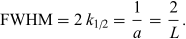
the full width at half maximum is
,
the full width at half maximum is
 |
(7)
|
To find the extrema, take the derivative
 |
(8)
|
and equate to zero. The first two roots are  and 10.7061..., corresponding to the first sidelobe
minimum (
and 10.7061..., corresponding to the first sidelobe
minimum (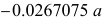 )
and maximum (
)
and maximum ( ),
respectively.
),
respectively.
