


A half-arc-transitive graph is a graph that is both edge-transitive and vertex-transitive but not arc-transitive (Conder and Žitnik 2016). Such graphs are also called 1/2-transitive graphs (Alspach et al. 1994).
Half-arc-transitive graphs should not be confused with semisymmetric graphs. Both classes are regular and edge-transitive but not arc-transitive; half-arc-transitive graphs are vertex-transitive, whereas semisymmetric graphs are not.
Tutte (1966) proved that a connected graph of odd degree that is both vertex-transitive and edge-transitive must be arc-transitive. Consequently, a half-arc-transitive graph must have even degree, but Tutte did not construct one. Bouwer (1970) gave the first examples and proved that they exist in every even degree greater than 2. The Doyle graph on 27 vertices is the unique smallest half-arc-transitive graph (Alspach et al. 1994).
The numbers of connected quartic half-arc-transitive graphs on  , 2, ... vertices are 0,
0, 0, 0, 0, 0, 0, 0, 0, 0, 0, 0, 0, 0, ... (OEIS A398351).
The orders
, 2, ... vertices are 0,
0, 0, 0, 0, 0, 0, 0, 0, 0, 0, 0, 0, 0, ... (OEIS A398351).
The orders  for which at least one such graph
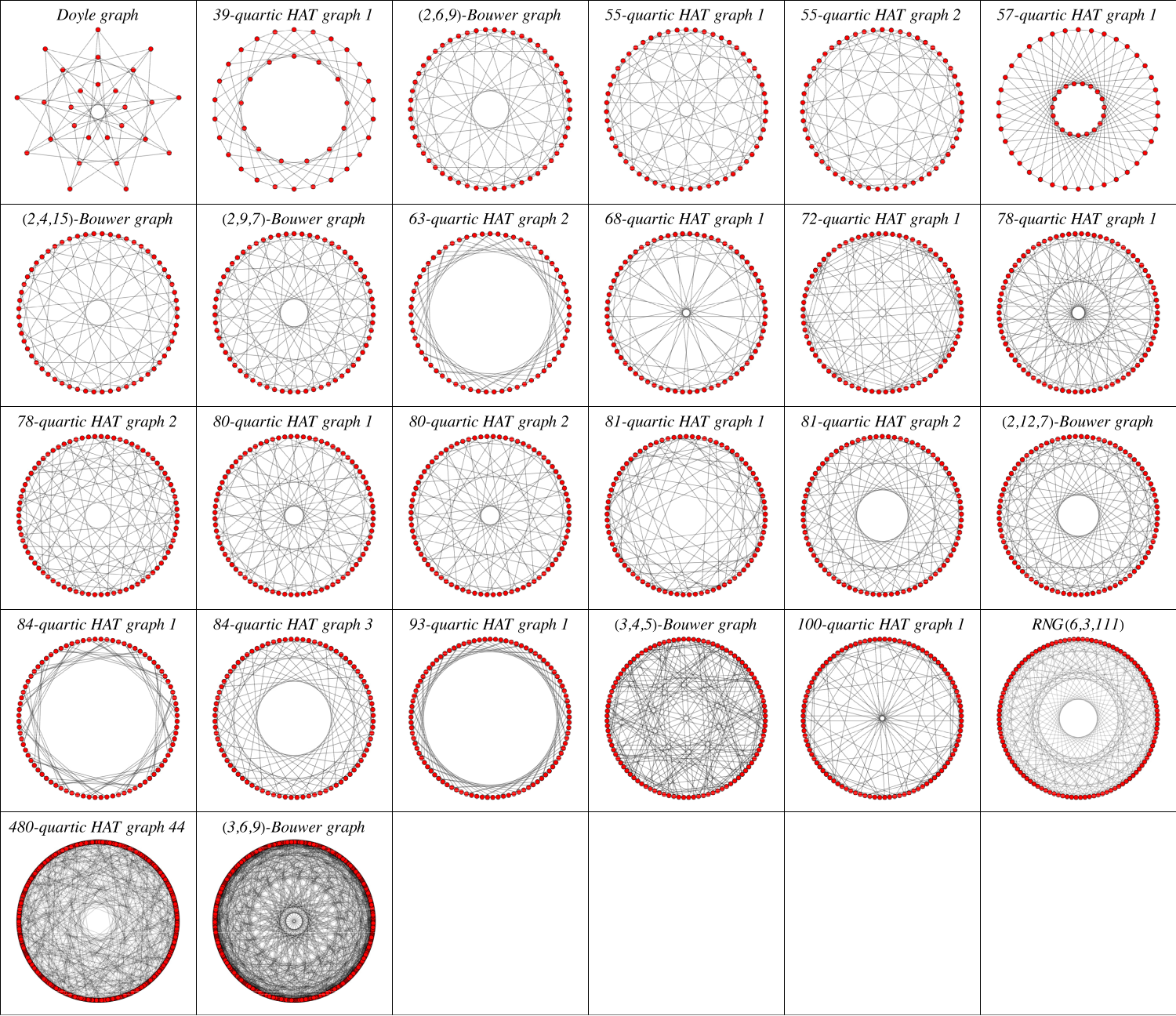
exists are 27, 39, 54, 55, 57, 60, 63, 68, 72, 78, 80, 81, 84, 93, 100, ... (OEIS
A398352), illustrated above.
for which at least one such graph
exists are 27, 39, 54, 55, 57, 60, 63, 68, 72, 78, 80, 81, 84, 93, 100, ... (OEIS
A398352), illustrated above.
Marušič and Xu (1997) proved that a connected cubic graph  is a 1-arc-regular graph iff its line graph
  is quartic and half-arc-transitive.
Equivalently, the line graph construction gives a one-to-one correspondence between connected cubic 1-arc-regular
graphs and quartic half-arc-transitive graphs
of girth 3.
is quartic and half-arc-transitive.
Equivalently, the line graph construction gives a one-to-one correspondence between connected cubic 1-arc-regular
graphs and quartic half-arc-transitive graphs
of girth 3.
The following table gives five examples, where the second column gives the name in the census of Potočnik et al. (2015).
Foster graph  | census name of  |
 | HAT[39,1] |
 | HAT[57,1] |
 | HAT[63,2] |
 | HAT[84,1] |
 | HAT[93,1] |
Another example is a 6-regular nonplanar graph of diameter 3 on 111 vertices. G. Exoo found this graph while investigating the degree-diameter problem for regular nonplanar graphs of diameter 3, without considering its symmetry properties (E. Weisstein, Jul. 16, 2018).
Conder and Žitnik (2016) proved that almost all Bouwer graphs are half-arc-transitive. In particular,  is half-arc-transitive whenever
  and
and  . Jajcay et al. (2019) also exhibited infinitely
many sextic half-arc-transitive bicirculant
graphs.
. Jajcay et al. (2019) also exhibited infinitely
many sextic half-arc-transitive bicirculant
graphs.
Named quartic constructions having half-arc-transitive members include the power spidergraph, mutant power spidergraph, and Marušič-Šparl Z graph families (Potočnik and Wilson 2020).
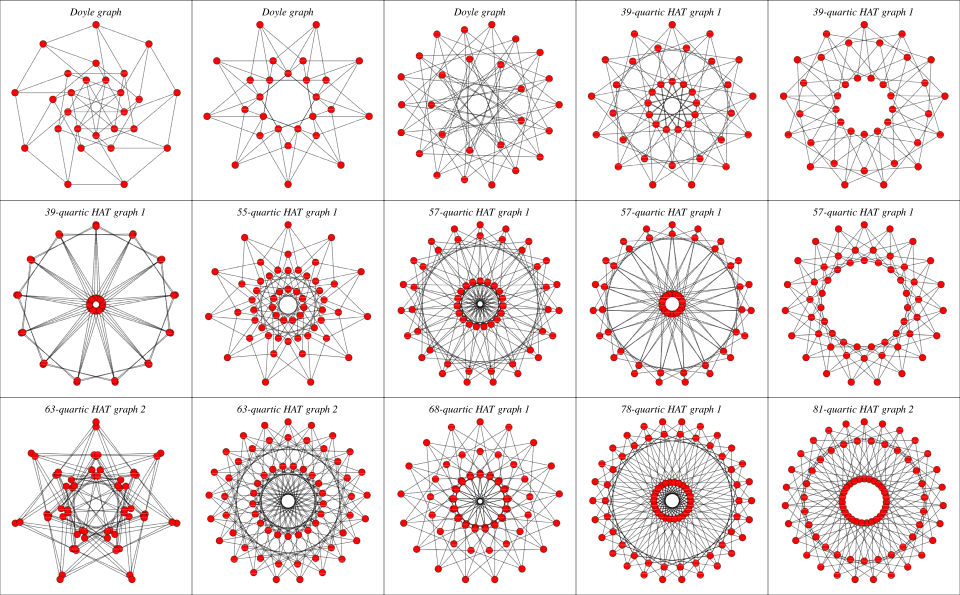
A number of half-arc-transitive graphs have unit-distance embeddings, some examples of which are illustrated above.
The class of half-arc-transitive graphs is implemented in the Wolfram Language as GraphData["HalfArcTransitive"].
