

The name Hajós graph is used for two different graphs.
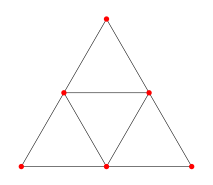
In one usage (Berge 1989, p. 6; Brandstädt et al. 1999), it denotes the Sierpiński gasket graph  , illustrated above. Berge (1989, p. 6) describes this
graph as "a triangle
inscribed in a hexagon." This graph
has six vertices and nine edges.
It is the complete-core 3-sun graph, constructed from
a triangle graph by adding one new vertex
for each edge, joining it to that edge's
endpoints and retaining all three original edges.
, illustrated above. Berge (1989, p. 6) describes this
graph as "a triangle
inscribed in a hexagon." This graph
has six vertices and nine edges.
It is the complete-core 3-sun graph, constructed from
a triangle graph by adding one new vertex
for each edge, joining it to that edge's
endpoints and retaining all three original edges.
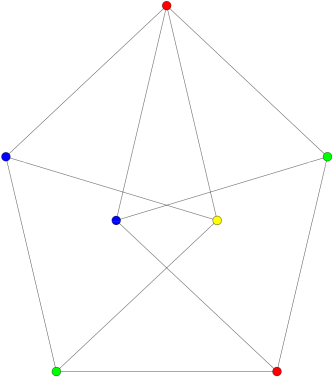
In another usage (Bondy and Murty 2008, p. 358), the name denotes the Moser spindle, illustrated above. Bondy and Murty (2008) do not explain the origin of this name or cite a source for this naming usage. This is a unit-distance graph with seven vertices, eleven edges and chromatic number 4. The two meanings therefore denote distinct graphs, not different embeddings of the same graph.

 -Colorings of a Graph." Disc. Math. 74,
3-14, 1989.
-Colorings of a Graph." Disc. Math. 74,
3-14, 1989.