

The Haar condition holds for a set of vectors in Euclidean n-space if every set
of  vectors is
linearly independent (Cheney 1999). Expressed
otherwise, each selection of
 vectors from such a set
is a basis for n-space.
In the function-space setting, let  be a vector space of finite
dimension
 consisting of real-valued continuous functions on an interval
 with
 . For a basis
 of
 and
 distinct points
 , let the matrix
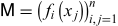 . The Haar condition requires the
determinant to satisfy
 |
for every such choice of points. Equivalently, every nonzero function in  has at most
 distinct zeros in
 (Powell 1981, pp. 313-316). Thus the evaluation vectors
 at
 distinct arguments form a basis
for
 .
A system of functions satisfying the Haar condition is sometimes termed a Tchebycheff system (Cheney 1999).
