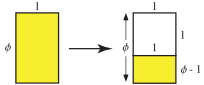
A golden rectangle is a rectangle having sides in the ratio ,
where the golden ratio has the property that partitioning the original rectangle
into a square and new rectangle
results in a new rectangle having sides with a ratio
.
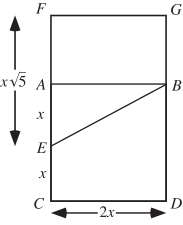
Euclid used the following construction to construct them. Draw the square, call the midpoint of , so that . Now draw the segment , which has length
(1)
and construct
with this length. Now complete the rectangle, which is golden since
(2)
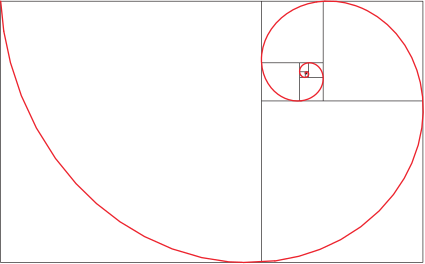
Successive points dividing a golden rectangle into squares lie on a logarithmic spiral (Wells 1991, p. 39;
Livio 2002, p. 119) which is sometimes known as the golden
spiral.
The spiral is not actually tangent at these points, however, but passes through them and intersects the adjacent side, as illustrated
above.
If the top left corner of the original square is positioned at (0, 0), the center of the spiral occurs at the position
(3)
(4)
(5)
(6)
(7)
(8)
(9)
(10)
(11)
and the parameters of the spiral are given by
(12)
(13)
(14)
(15)
A rectangle with length-to-height ratio can be dissected into three similar rectangles as
illustrated above (Pegg 2019).


 ,
where the golden ratio
,
where the golden ratio  has the property that partitioning the original rectangle
into a square and new rectangle
results in a new rectangle having sides with a ratio
has the property that partitioning the original rectangle
into a square and new rectangle
results in a new rectangle having sides with a ratio
 .
.
 , call
  the midpoint of
  , so that
  . Now draw the segment
  , which has length

 with this length. Now complete the rectangle
  , which is golden since



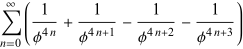


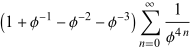








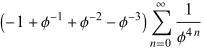


 are given by


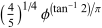


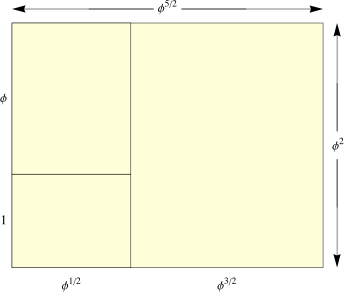
 can be dissected into three similar rectangles as
illustrated above (Pegg 2019).
can be dissected into three similar rectangles as
illustrated above (Pegg 2019).

 ,
,
 ,
,  ,
,  ." Mar. 7, 2019.