A Goldbach partition of an even number is an unordered pair of primes such that (Oliveira e Silva). Letting denote the number of Goldbach partitions of without regard to order, the number of ways of writing as a sum of two prime
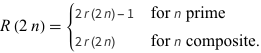
numbers taking the order of the two primes into account is
The
and
convention above is used by Oliveira e Silva. The NIST Digital Library of Mathematical
Functions instead denotes the unordered partition count by . In analytic number
theory, Bhowmik and Halupczok (2020) use , where the sum is over primes, for the
ordered unweighted count. They use for the weighted count, where
is the Mangoldt function, while Brüdern
et al. (2019) denote this weighted function by . Veritasium (2025) uses for the unordered partition count. This is a local notation for Goldbach partitions and is unrelated
to the standard functions and that count prime factors.
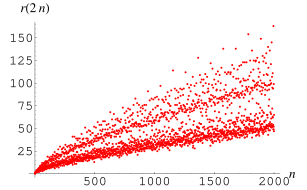
A plot of ,
sometimes known as Goldbach's comet, for up to 2000 is illustrated above.
The following table summarizes the values of several variants of for , 4, ....
Bhowmik, G. and Halupczok, K. "Asymptotics of Goldbach Representations." In Various Aspects of Multiple Zeta Functions.Adv.
Stud. Pure Math.84. Tokyo, Japan: Mathematical Society of Japan, pp. 1-21,
2020. https://doi.org/10.2969/aspm/08410001.Brüdern,
J.; Kaczorowski, J.; and Perelli, A. "Explicit Formulae for Averages of Goldbach
Representations." Trans. Amer. Math. Soc.372, 6981-6999, 2019.
https://doi.org/10.1090/tran/7799.Clawson,
C. Mathematical
Mysteries: The Beauty and Magic of Numbers. New York: Plenum Press, p. 241,
1996.Doxiadis, A. Uncle
Petros and Goldbach's Conjecture. Faber & Faber, 2001.Grave,
D. A. Traktat z Algebrichnogo Analizu, Vol. 2. Kiev, Ukraine: Vidavnitstvo
Akademiia Nauk, p. 19, 1938.Halberstam, H. and Richert, H.-E. Sieve
Methods. New York: Academic Press, 1974.Lehmer, D. H. Guide
to Tables in the Theory of Numbers. Bulletin No. 105. Washington, DC:
National Research Council, p. 80, 1941.Liang, W.; Yan, H.; and
Zhi-cheng, D. "Fractal in the Statistics of Goldbach Partition." 12 Jan
2006. https://arxiv.org/abs/nlin/0601024.National
Institute of Standards and Technology. "Goldbach Conjecture." §27.13(ii)
in Digital Library of Mathematical Functions.https://dlmf.nist.gov/27.13#ii.Oliveira
e Silva, T. "Goldbach Conjecture Verification." https://sweet.ua.pt/tos/goldbach.html.Sinisalo,
M. K. "Checking the Goldbach Conjecture up to ." Math. Comput.61, 931-934,
1993.Veritasium. "The Obviously True Theorem No One Can Prove."
Jun. 20, 2025. https://www.youtube.com/watch?v=x32Zq-XvID4.Sloane,
N. J. A. Sequences A001031/M0213,
A002375/M0104, and A045917
in "The On-Line Encyclopedia of Integer Sequences."


 is an unordered pair of primes
  such that
  (Oliveira e Silva). Letting
  denote the number of Goldbach partitions of
  without regard to order, the number of ways of writing
  as a sum of two prime
numbers taking the order of the two primes into account is
as a sum of two prime
numbers taking the order of the two primes into account is
 or, equivalently, that
  , for every even integer
  .
.
 and
and  convention above is used by Oliveira e Silva. The NIST Digital Library of Mathematical
Functions instead denotes the unordered partition count by
convention above is used by Oliveira e Silva. The NIST Digital Library of Mathematical
Functions instead denotes the unordered partition count by  . In analytic number
theory, Bhowmik and Halupczok (2020) use
. In analytic number
theory, Bhowmik and Halupczok (2020) use  , where the sum is over primes, for the
ordered unweighted count. They use
, where the sum is over primes, for the
ordered unweighted count. They use  for the weighted count, where
 is the Mangoldt function, while Brüdern
et al. (2019) denote this weighted function by
is the Mangoldt function, while Brüdern
et al. (2019) denote this weighted function by  . Veritasium (2025) uses
  for the unordered partition count. This
  is a local notation for Goldbach partitions and is unrelated
to the standard functions
is a local notation for Goldbach partitions and is unrelated
to the standard functions  and
and  that count prime factors.
 ,
sometimes known as Goldbach's comet, for
,
sometimes known as Goldbach's comet, for  up to 2000 is illustrated above.
 for
for  , 4, ....
 1 or prime
 prime
prime odd prime
 ." Math. Comput. 61, 931-934,
1993.Veritasium. "The Obviously True Theorem No One Can Prove."
Jun. 20, 2025.
." Math. Comput. 61, 931-934,
1993.Veritasium. "The Obviously True Theorem No One Can Prove."
Jun. 20, 2025.