The Gini coefficient (or Gini ratio) is a summary statistic of the Lorenz
curve and a measure of inequality in a population. The Gini coefficient is most
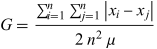
easily calculated from unordered size data as the "relative mean difference,"
i.e., the mean of the difference between every possible pair of individuals, divided
by the mean size ,
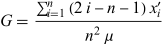
(Dixon et al. 1987, Damgaard and Weiner 2000). Alternatively, if the data is ordered by increasing size of individuals, is given by
(Dixon et al. 1988, Damgaard and Weiner 2000), correcting the typographical
error in the denominator given in the original paper (Dixon et al. 1987).
The Gini coefficient ranges from a minimum value of zero, when all individuals are equal, to a theoretical maximum of one in an infinite population in which every individual
except one has a size of zero. It has been shown that the sample Gini coefficients
defined above need to be multiplied by in order to become unbiased
estimators for the population coefficients.
Damgaard, C. and Weiner, J. "Describing Inequality in Plant Size or Fecundity." Ecology81, 1139-1142, 2000.Dixon,
P. M.; Weiner, J.; Mitchell-Olds, T.; and Woodley, R. "Bootstrapping the
Gini Coefficient of Inequality." Ecology68, 1548-1551, 1987.Dixon,
P. M.; Weiner, J.; Mitchell-Olds, T.; and Woodley, R. "Erratum to 'Bootstrapping
the Gini Coefficient of Inequality.' " Ecology69, 1307, 1988.Gini,
C. "Variabilitá e mutabilita." 1912. Reprinted in Memorie di
metodologia statistica (Ed. E. Pizetti and T. Salvemini.) Rome, Italy:
Libreria Eredi Virgilio Veschi, 1955.Glasser, G. J. "Variance
Formulas for the Mean Difference and Coefficient of Concentration." J. Amer.
Stat. Assoc.57, 648-654, 1962.Sen, A. On
Economic Inequality. Oxford, England: Clarendon Press, 1973.


 is a summary statistic of the Lorenz
curve and a measure of inequality in a population. The Gini coefficient is most
easily calculated from unordered size data as the "relative mean difference,"
i.e., the mean of the difference between every possible pair of individuals, divided
by the mean size
is a summary statistic of the Lorenz
curve and a measure of inequality in a population. The Gini coefficient is most
easily calculated from unordered size data as the "relative mean difference,"
i.e., the mean of the difference between every possible pair of individuals, divided
by the mean size  ,
,
 is given by
 in order to become unbiased
estimators for the population coefficients.
in order to become unbiased
estimators for the population coefficients.
