

A generalized Steiner system  is a
 -ary constant-weight code
of length
 and weight
 , with minimum Hamming
distance at least
 ,
in which every word of weight
 is covered by exactly one codeword
(Etzion 1997, Wang et al. 2026). A word covers another when its nonzero coordinates
include those of the other and their symbols agree at every such coordinate. Here
 and
 are integers, and one symbol in the
 -symbol alphabet is designated zero. The parameter
 denotes alphabet size; literature using the group size instead
writes
 in the last parameter. These are distinct from the subspace versions of Steiner
systems in finite geometry.
Writing  for the largest size of a
 -ary constant-weight code
with the indicated length, minimum distance, and weight, the covering count gives
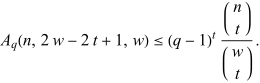 |
Equality holds exactly when the code is a generalized Steiner system. Necessary divisibility conditions are
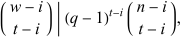 |
for  . Wang et al. (2026, Theorem 1.3)
proved that, for every fixed
 and
 ,
these conditions are also sufficient for every sufficiently large
 . The result is nonconstructive, with no explicit threshold
for
 supplied.
Their systems can additionally be chosen so that the supports of distinct codewords intersect in at most  coordinates. The supports then form a simple
 -
 design: each
 -subset is contained in exactly
 distinct supports (Wang et al. 2026, Theorem 1.5).
This extra support property forces
 ; it is stronger than the definition and
need not hold at smaller admissible lengths.
For  , fixing a coordinate and one nonzero symbol, retaining
the codewords with that symbol at the chosen coordinate,
and deleting it gives a
 (Etzion 1997, Wang et al. 2026).

 and Generalized Designs." Disc. Math. 169, 55-82, 1997.