These are the sums of elements on successive diagonals of a left-justified Pascal's triangle beginning in the leftmost column and moving in steps of up and 1 right. The case equals the usual Fibonacci
number. These numbers satisfy the identities
(2)
(3)
(4)
(5)
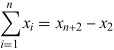
(Bicknell-Johnson and Spears 1996). For the special case ,
(6)
Bicknell-Johnson and Spears (1996) give many further identities.
Horadam (1965) defined the generalized Fibonacci numbers as , where , , , and are integers, , , and for . They satisfy the identities
(7)
(8)
(9)
(10)
where
(11)
(12)
(Dujella 1996). The final above result is due to Morgado (1987) and is called the
morgado identity.
Another generalization of the Fibonacci numbers is denoted . Given and , define the generalized Fibonacci number by for ,
Bicknell-Johnson, M. and Spears, C. P. "Classes of Identities for the Generalized Fibonacci Numbers for Matrices with Constant Valued Determinants."
Fib. Quart.34, 121-128, 1996.Bicknell, M. "A Primer
for the Fibonacci Numbers, Part VIII: Sequences of Sums from Pascal's Triangle."
Fib. Quart.9, 74-81, 1971.Dujella, A. "Generalized
Fibonacci Numbers and the Problem of Diophantus." Fib. Quart.34,
164-175, 1996.Horadam, A. F. "Generating Functions for Powers
of a Certain Generalized Sequence of Numbers." Duke Math. J.32,
437-446, 1965.Horadam, A. F. "Generalization of a Result of
Morgado." Portugaliae Math.44, 131-136, 1987a.Horadam,
A. F. and Shannon, A. G. "Generalization of Identities of Catalan
and Others." Portugaliae Math.44, 137-148, 1987b.Morgado,
J. "Note on Some Results of A. F. Horadam and A. G. Shannon concerning a Catalan's
Identity on Fibonacci Numbers." Portugaliae Math.44, 243-252,
1987.


 and the recurrence
relation
and the recurrence
relation

 up and 1 right. The case
  equals the usual Fibonacci
number. These numbers satisfy the identities
equals the usual Fibonacci
number. These numbers satisfy the identities




 ,
,

 as
as  , where
  ,
,  ,
,  , and
, and  are integers,
  ,
,  , and
, and  for
for  . They satisfy the identities









 . Given
  and
and  , define the generalized Fibonacci number by
  for
for  ,
,



 for Matrices with Constant Valued Determinants."
Fib. Quart. 34, 121-128, 1996.Bicknell, M. "A Primer
for the Fibonacci Numbers, Part VIII: Sequences of Sums from Pascal's Triangle."
Fib. Quart. 9, 74-81, 1971.Dujella, A. "Generalized
Fibonacci Numbers and the Problem of Diophantus." Fib. Quart. 34,
164-175, 1996.Horadam, A. F. "Generating Functions for Powers
of a Certain Generalized Sequence of Numbers." Duke Math. J. 32,
437-446, 1965.Horadam, A. F. "Generalization of a Result of
Morgado." Portugaliae Math. 44, 131-136, 1987a.Horadam,
A. F. and Shannon, A. G. "Generalization of Identities of Catalan
and Others." Portugaliae Math. 44, 137-148, 1987b.Morgado,
J. "Note on Some Results of A. F. Horadam and A. G. Shannon concerning a Catalan's
Identity on Fibonacci Numbers." Portugaliae Math. 44, 243-252,
1987.
for Matrices with Constant Valued Determinants."
Fib. Quart. 34, 121-128, 1996.Bicknell, M. "A Primer
for the Fibonacci Numbers, Part VIII: Sequences of Sums from Pascal's Triangle."
Fib. Quart. 9, 74-81, 1971.Dujella, A. "Generalized
Fibonacci Numbers and the Problem of Diophantus." Fib. Quart. 34,
164-175, 1996.Horadam, A. F. "Generating Functions for Powers
of a Certain Generalized Sequence of Numbers." Duke Math. J. 32,
437-446, 1965.Horadam, A. F. "Generalization of a Result of
Morgado." Portugaliae Math. 44, 131-136, 1987a.Horadam,
A. F. and Shannon, A. G. "Generalization of Identities of Catalan
and Others." Portugaliae Math. 44, 137-148, 1987b.Morgado,
J. "Note on Some Results of A. F. Horadam and A. G. Shannon concerning a Catalan's
Identity on Fibonacci Numbers." Portugaliae Math. 44, 243-252,
1987.