

A Gaussian mixture model is a mixture distribution whose component distributions are normal distributions. Its probability density function has the form
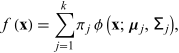 |
where  ,
,
 ,
and
,
and  is the probability density function
of a multivariate normal distribution
with mean
is the probability density function
of a multivariate normal distribution
with mean  and covariance matrix
  .
.
The component label is an unobserved categorical random variable. Model parameters are often estimated by alternately estimating component memberships and maximizing the resulting expected log likelihood function. A Gaussian mixture can be unimodal or multimodal, depending on its weights, means, and covariance matrices.
Okahara and Kobayashi (2026) proved that a mixture of three normal distributions with positive weights and a common positive
definite covariance matrix has at most four
modes in every dimension  , and that four is attained. If the whitened means are
collinear or form a right triangle or obtuse
triangle, the sharp maximum is three. The result includes degenerate modes. Okahara
and Kobayashi (2026) disclose ChatGPT assistance with mathematical exploration, proposed
arguments, code, and checks. The authors take responsibility for the mathematical
content.
, and that four is attained. If the whitened means are
collinear or form a right triangle or obtuse
triangle, the sharp maximum is three. The result includes degenerate modes. Okahara
and Kobayashi (2026) disclose ChatGPT assistance with mathematical exploration, proposed
arguments, code, and checks. The authors take responsibility for the mathematical
content.
