

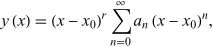
A Frobenius solution of a homogeneous linear second-order ordinary differential equation near a regular
singular point  is a solution of the form
 |
(1)
|
where  and the power series converges near
  . The exponent
  is a root of the indicial
equation. The Frobenius method determines
is a root of the indicial
equation. The Frobenius method determines
 and the coefficients, whereas the Frobenius solution
is the resulting function.
and the coefficients, whereas the Frobenius solution
is the resulting function.
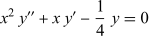
The exponent need not be an integer. For example,
 |
(2)
|
has the linearly independent Frobenius solutions  and
and  on
on  ,
corresponding to the indicial equation
,
corresponding to the indicial equation
 |
(3)
|
Neither solution has a Laurent series about zero.
