


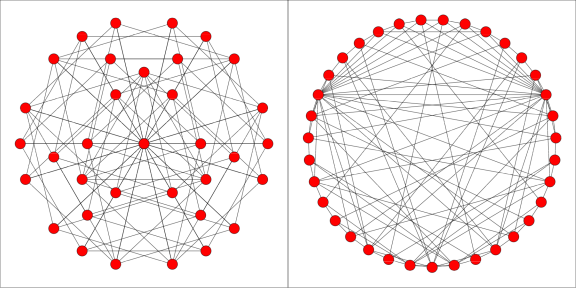
The Frankl-Hubai-Pálvölgyi graph is a name used here for the graph illustrated above with 35 vertices and 106 edges.
It encodes the 34-point unit-distance graph  of Frankl et al. (2023), which has no proper
coloring with four colors when its distinguished origin
is allowed two colors. The encoding with 35 vertices
replaces the origin by two coincident vertices, joins them by a distance-0 edge,
and gives both copies the origin's unit-distance neighbors.
Thus, an ordinary proper coloring assigns two
distinct colors to the origin while excluding both colors
from its neighbors. The resulting abstract graph has chromatic number
5.
of Frankl et al. (2023), which has no proper
coloring with four colors when its distinguished origin
is allowed two colors. The encoding with 35 vertices
replaces the origin by two coincident vertices, joins them by a distance-0 edge,
and gives both copies the origin's unit-distance neighbors.
Thus, an ordinary proper coloring assigns two
distinct colors to the origin while excluding both colors
from its neighbors. The resulting abstract graph has chromatic number
5.
Frankl et al. (2023) described  as the first example found whose relevant coloring property
could be checked quickly without a computer. They used it in a proposed route to
a human-verifiable lower bound of 5 for the Hadwiger-Nelson
problem.
as the first example found whose relevant coloring property
could be checked quickly without a computer. They used it in a proposed route to
a human-verifiable lower bound of 5 for the Hadwiger-Nelson
problem.
The Frankl-Hubai-Pálvölgyi graph is implemented in the Wolfram Language as GraphData["FranklHubaiPalvolgyiGraph"].
