

The Fisher linear discriminant is a linear transformation to one dimension used to separate two classes of multivariate
observations. Let the class sample means be  and
and  , and let
  be the sum of the two within-class scatter matrices.
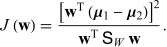
A Fisher linear discriminant is obtained by choosing a nonzero vector
be the sum of the two within-class scatter matrices.
A Fisher linear discriminant is obtained by choosing a nonzero vector  that maximizes Fisher's criterion.
When
that maximizes Fisher's criterion.
When  is a nonsingular matrix, every maximizing direction is proportional to
 |
The resulting scalar  can then be compared with a threshold to classify an observation.
This construction forms the two-class basis of linear discriminant analysis.
can then be compared with a threshold to classify an observation.
This construction forms the two-class basis of linear discriminant analysis.
