

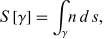
Fermat's principle, also called the principle of least time, states that a light ray between fixed endpoints makes its optical path length stationary. For a curve  , the optical path length is the functional
 |
(1)
|
where  is the index of refraction and
 is the arc length element.
In a stationary, isotropic, nondispersive medium the ray speed is
 , where
 is the speed of light in vacuum. The travel time is then
 , so the two functionals
have the same stationary paths. If
 is constant,
 is proportional to arc length
and the ray is a straight line (Open University 2016, pp. 28-30).
Consider two uniform media separated by the x-axis, with indices of refraction  and
 . The two segments from fixed
points
 and
 to the crossing point
 give
 |
(2)
|
where  and
 . For
 , differentiating and
setting
 gives
 |
(3)
|
where  and
 are the angles the two segments make with the normal to
the interface. This is Snell's law of refraction, which Fermat derived using this
principle (Andersen 1983).
