


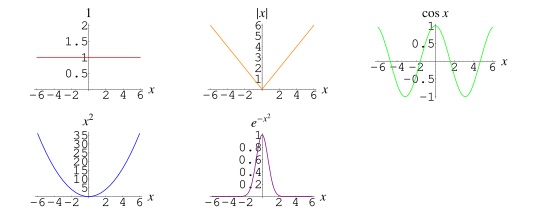
An even function is a univariate function  satisfying
 . Geometrically, such functions
are symmetric about the
 -axis. Examples of even functions include 1 (or, in general,
any constant function),
 ,
 ,
 , and
 .
For any univariate function  whose domain is symmetric
about 0, the even part
 is defined by
 |
It is even, and  is the odd part of
 . For a univariate
polynomial, the even part is the sum of the monomials
containing even powers of the variable.
An even function times an odd function is odd, while the sum or difference of two even functions is even. The product or quotient of two even functions is again even.
If a univariate function that is even is differentiable, then its derivative
is an odd function. If an even function is integrable
over a symmetric interval  , where
 , then its integral
over
 is twice its integral over the interval
 . Similarly, if an odd
function is differentiable, then its derivative
is an even function. If an odd function is integrable
over
 , then its integral over
 is zero. For
 , the two one-sided improper
integrals must each be finite.
Ostensibly, one can define a similar notion for multivariate functions  by saying that such a function is even iff
 |
Even so, such functions are unpredictable and very well may lose many of the desirable geometric properties possessed by univariate
functions. For example, both  and
 satisfy this identity while the constant
slices
 and
 of
 and
 are odd and even, respectively.
Differentiability and integrability properties are similarly unclear.
The maclaurin series of an even function contains only even powers of  .
