

Erdős's distance-product volume problem asks for the greatest volume of the region of points whose product of distances
to  specified points in
 is at most 1. The specified points
may coincide. Pólya (1928) proved the planar bound using polynomial lemniscates.
For  , Goel (2026a) reports a weighted result. If
 and
 are positive weights of sum 1, then the region
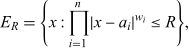 |
where  , has volume at most
that of a ball of radius
 . Equality holds exactly when all the specified points
coincide. Equal weights and
 give Erdős's original question.
If  falls short of the maximal volume by a fraction
 , it contains a ball of radius at least
 as
 .
The estimate is uniform over the placements and weights for each fixed
 , and the coefficient is sharp (Goel 2026b). The
expanded paper extends the volume and stability conclusions to compactly supported
probability measures. For finitely many weighted
points, it also reports that the corresponding volume bound
holds for all placements when the weighted geometric mean of the distances is replaced
by the weighted power mean of order
 exactly for
 .
Goel credits AI systems with the mathematical work. The focused paper reports Lean verification of the volume and three-dimensional stability deductions from stated analytic hypotheses. The expanded stability result in higher dimensions and the power-mean extension are written proofs.

 ." Hexagon, Nov. 25, 2026a.