

The Erdős box problem asks for the largest size  of a subset of
 containing no Cartesian
product
 in which every
 has exactly two elements (Erdős 1964). Equivalently, it is an extremal problem
for complete
 -partite
 -uniform hypergraphs
with two vertices in every part.
For  , Menezes (2026) constructed, for every power
 of 2, a subset
of
 of size
 containing no such box. The whole grid partitions into
 isomorphic box-free sets. For every
positive integer
 , this gives
 |
The known general upper bound has exponent  , so the exact exponent in four dimensions remains
open.
Let  be the least positive integer
 such that every
 -coloring of
 has a monochromatic box. The same construction gives
 for powers of 2 and
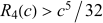 for all integers
 .

 Lower Bound for the Four-Dimensional ErdŐs Box Problem." 11 Nov 2026.