

For an elliptic curve  over
over  , the conductor measures its bad reduction and the ramification
of its torsion points. It is the positive
integer
, the conductor measures its bad reduction and the ramification
of its torsion points. It is the positive
integer
 |
(1)
|
where the product is over primes and  is the local conductor
exponent. The primes dividing
is the local conductor
exponent. The primes dividing  are exactly the primes at which
  has bad reduction.
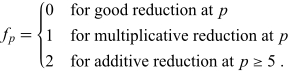
The local exponents are
 |
(2)
|
At the primes 2 and 3, additive reduction can include an additional contribution from wild ramification. In this case,  and
and  . The exponents, together with the reduction
type and a local minimal equation in Weierstrass
form, can be computed by Tate's algorithm.
The conductor is invariant under isogeny over
. The exponents, together with the reduction
type and a local minimal equation in Weierstrass
form, can be computed by Tate's algorithm.
The conductor is invariant under isogeny over  .
.
An elliptic curve over  is semistable iff its conductor
is squarefree. By the modularity theorem,
is semistable iff its conductor
is squarefree. By the modularity theorem,
 is also the modular form level of the weight-two
modular newform associated with
is also the modular form level of the weight-two
modular newform associated with  , and it occurs in the functional
equation of the Hasse-Weil L-function
of
, and it occurs in the functional
equation of the Hasse-Weil L-function
of  .
.

 ."
."