

An Edwards curve over a field  of field characteristic
other than 2 is the affine plane curve
of field characteristic
other than 2 is the affine plane curve
 |
(1)
|
where  and
and  . Edwards (2007) introduced the
underlying elliptic curve normal form, and Bernstein
and Lange (2007) developed the modern one-parameter form above. For points
. Edwards (2007) introduced the
underlying elliptic curve normal form, and Bernstein
and Lange (2007) developed the modern one-parameter form above. For points  and
and  , the elliptic
curve group law is
, the elliptic
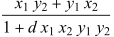
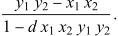
curve group law is  ,
where
,
where
 |  |  |
(2)
|
 |  |  |
(3)
|
The identity element is  , and the inverse element
of
, and the inverse element
of  is
is  . If
. If  is a nonsquare in
  , the addition formulas are complete (Bernstein and Lange 2007).
An Edwards curve is the
, the addition formulas are complete (Bernstein and Lange 2007).
An Edwards curve is the  special case of a twisted Edwards curve.
