TOPICS
Search

Eckart-Young Theorem


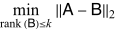
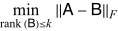
The Eckart-Young theorem states that the best rank-k approximation to a matrix A in the Frobenius norm or spectral norm is obtained by truncating its singular value decomposition. If the singular values satisfy sigma_1>=...>=sigma_r>0, k is an integer with 0<=k<r, and A_k retains the first k terms of the singular value decomposition, then

min_(rank(B)<=k)||A-B||_2=sigma_(k+1)
(1)
min_(rank(B)<=k)||A-B||_F=(sum_(j=k+1)^(r)sigma_j^2)^(1/2).
(2)

For k>=r, the best approximation is A itself and both errors are zero, including the case of a zero matrix.


See also

Frobenius Norm, Matrix Norm, Singular Value Decomposition

Explore with Wolfram|Alpha

References

Golub, G. H. and Van Loan, C. F. Matrix Computations, 4th ed. Baltimore, MD: Johns Hopkins University Press, 2013.

Cite this as:

Weisstein, Eric W. "Eckart-Young Theorem." From MathWorld--A Wolfram Resource. https://mathworld.wolfram.com/Eckart-YoungTheorem.html

Subject classifications