

A dungeon number, also called a descending dungeon, is a value formed by iteration of a binary operation written with nested subscripts (Applegate et al. 2009). For real
numbers  ,
write the decimal expansion of
 as
 , choosing the expansion that is
not eventually all 9s. Define
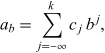 |
where the  are decimal digits,
 , and
 . For
 , the right side is a convergent
series. Its value generally differs from
 , since the same decimal digits
are evaluated at a new base.
The placement of parentheses matters. For example,  , whereas
 . By default, evaluation starts with the lowest
subscript, so a three-entry dungeon is
 rather than
 (Applegate et al. 2009).
Four integer sequences arise by taking the entries 10, 11, ...,  or the reverse order and evaluating from the bottom upwards or the top downwards.
All four are indexed from
 , with initial values as follows (Applegate et al. 2009).
| entries | evaluation | OEIS | initial values |
10, 11, ...,  | bottom upwards | A121263 | 10, 11, 13, 16, 20, 25, 31, 38, 46, 55, 65, ... |
10,
11, ...,  | top downwards | A121265 | 10, 11, 13, 16, 20, 30, 48, 76, 132, 420, 1640, ... |
 ,  , ..., 10 | bottom upwards | A121295 | 10, 11, 13, 16, 20, 25, 31, 38, 46, 55, 110, ... |
 ,  , ..., 10 | top downwards | A121296 | 10, 11, 13, 16, 20, 28, 45, 73, 133, 348, 4943, ... |
For each of these four sequences, Applegate et al. (2009) proved
 |
as  ,
where
 is its
 th
term and
 denotes asymptotic equivalence.
