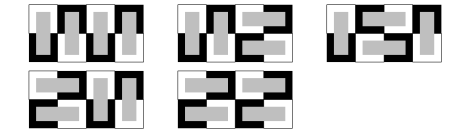
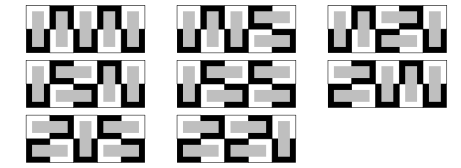
The Fibonacci number gives the number of ways for dominoes to cover a checkerboard, as illustrated
in the diagrams above (Dickau).
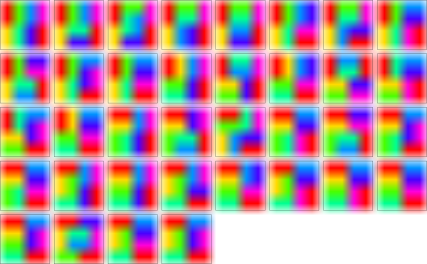
The numbers of domino tilings, also known as dimer coverings, of a square for , 2, ... are given by 2, 36, 6728, 12988816, ... (OEIS A004003). The 36 tilings on the square are illustrated above. A formula for these numbers
is given by
(1)
Writing
(2)
gives the surprising result
(3)
(John and Sachs 2000). For , 2, ..., the first few terms are 1, 3, 29, 5, 5, 7, 25,
9, 9, 11, 21, ... (OEIS A143234).
Cohn, H. "2-adic Behavior of Numbers of Domino Tilings." Elec. J. Combin.6, R14, 1999. https://doi.org/10.37236/1446.Dickau,
R. M. "Fibonacci Numbers." https://www.robertdickau.com/fibboard.html.Finch,
S. R. "Monomer-Dimer Constants." §5.23 in Mathematical
Constants. Cambridge, England: Cambridge University Press, pp. 406-407,
2003.Fisher, M. E. "Statistical Mechanics of Dimers on a Plane
Lattice." Phys. Rev.124, 1664-1672, 1961.Jockusch,
W. "Perfect Matchings and Perfect Squares." J. Combin. Theory Ser. A67,
100-115, 1994.John, P. E. and Sachs, H. "On a Strange Observation
in the Theory of the Dimer Problem." Disc. Math.216, 211-219,
2000.Propp, J. "A Reciprocity Theorem for Domino Tilings."
Elec. J. Combin.8, No. 1, R18, 2001. https://doi.org/10.37236/1562.Schroeppel,
R. Item 111 in Beeler, M.; Gosper, R. W.; and Schroeppel, R. HAKMEM.
Cambridge, MA: MIT Artificial Intelligence Laboratory, Memo AIM-239, p. 48,
Feb. 1972. https://www.inwap.com/pdp10/hbaker/hakmem/polyominos.html#item111.Sloane,
N. J. A. Sequences A004003/M2160,
A130834, A143233,
and A143234 in "The On-Line Encyclopedia
of Integer Sequences."



 gives the number of ways for
  dominoes to cover a
  checkerboard, as illustrated
in the diagrams above (Dickau).
checkerboard, as illustrated
in the diagrams above (Dickau).
 square for
  , 2, ... are given by 2, 36, 6728, 12988816, ... (OEIS A004003). The 36 tilings on the
  square are illustrated above. A formula for these numbers
is given by
square are illustrated above. A formula for these numbers
is given by
![A_n=2^(2n^2)product_(i=1)^nproduct_(j=1)^n[cos^2((ipi)/(2n+1))+cos^2((jpi)/(2n+1))].](/images/equations/DominoTiling/NumberedEquation1.svg)


 , 2, ..., the first few terms are 1, 3, 29, 5, 5, 7, 25,
9, 9, 11, 21, ... (OEIS A143234).
, 2, ..., the first few terms are 1, 3, 29, 5, 5, 7, 25,
9, 9, 11, 21, ... (OEIS A143234).


![1/(16pi^2)int_(-pi)^piint_(-pi)^piln[4+2costheta+2cosphi]dthetadphi](/images/equations/DominoTiling/Inline13.svg)



 is Catalan's
constant and
is Catalan's
constant and  is termed the dimer constant in OEIS A143233.



