

The dollar game is a solitaire game of redistribution on the vertices of a graph. In the version considered here, the board is
a nonempty finite graph  that is a connected graph
and a simple graph, and each vertex
has an integer balance, which may be negative.
A lending move at a vertex sends one dollar to each
of its neighbors. A borrowing move reverses
this transfer. Either move is allowed regardless of the current balances. The objective
is to make every balance nonnegative (Baker and Norine
2007, Numberphile 2018).
Write the balances as a column vector  and let
 be the Laplacian matrix
of
 . Lending at vertex
 changes
 to
 ,
where
 is the vector
with entry 1 at
 and 0 elsewhere. Borrowing adds
 . Thus a position is winnable iff
there is a column vector
 with integer entries such that
 |
where the inequality is interpreted coordinatewise (Baker and Norine 2007). Every move preserves the total balance  .
Let  have
 vertices and
 edges, and put
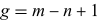 , its circuit rank. If
 , every initial position can be
won. For each
 ,
some initial position cannot be won (Baker and Norine 2007). A negative
total always prevents winning, but a nonnegative
total need not guarantee it.
Unlike the abelian sandpile model, these rules allow negative balances and borrowing and do not remove money at a sink (Baker 2013).
