

A dissociated set is a subset  of an Abelian group for which
a relation
 |
(1)
|
with finitely many nonzero coefficients  , requires
every coefficient to be zero. Equivalently, all finite subset sums are distinct. A finite
dissociated set therefore has
 distinct subset sums.
The powers of 2 in
 form a dissociated set, while
 does not because
 (Tao and Vu 2006).
The additive dimension of a finite set  is the largest size of a dissociated
subset of
 . A maximal dissociated subset
 satisfies
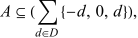 |
(2)
|
where the right side is a sumset. Otherwise, adjoining an element outside this sumset would preserve dissociation (Tao and Vu 2006).
An analytic inverse estimate relates additive dimension to Fourier series. For a finite  with
 , let
 . Bedert (2025) proved
 |
(3)
|
where  is the additive dimension,
 is an absolute constant,
and
 . Thus a small integral norm of this trigonometric
polynomial forces small additive dimension.

 -Estimates
for Trigonometric Series." 12 Feb 2025.