The discrete sine transform (DST) expresses a finite real sequence using sampled sine functions. One common form, the type-I
DST, is
where ,
..., .
With this normalization, the transformation is an orthogonal
transformation and is its own inverse. Different boundary conventions give several
other DST types. The discrete sine transform is the odd-extension counterpart of
the discrete cosine transform.


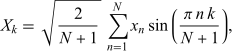
 ,
...,
,
...,  .
With this normalization, the transformation is an orthogonal
transformation and is its own inverse. Different boundary conventions give several
other DST types. The discrete sine transform is the odd-extension counterpart of
the discrete cosine transform.
.
With this normalization, the transformation is an orthogonal
transformation and is its own inverse. Different boundary conventions give several
other DST types. The discrete sine transform is the odd-extension counterpart of
the discrete cosine transform.
