

The Diffie-Hellman protocol is a method for two computer users to generate a shared private key with which they can then exchange information across an insecure channel.
Let the users be named Alice and Bob. First, they agree on two prime numbers  and
and  ,
where
,
where  is large (typically at least 512 bits) and
  is a primitive root modulo
 .
(In practice, it is a good idea to choose
.
(In practice, it is a good idea to choose  such that
  is also prime.) The numbers
  and
and  need not be kept secret from other users. Now Alice chooses
a large random number
need not be kept secret from other users. Now Alice chooses
a large random number  as her private key and Bob similarly chooses a large number
 .
Alice then computes
.
Alice then computes  , which she sends to Bob, and Bob computes
 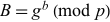 ,
which he sends to Alice.
,
which he sends to Alice.
Now both Alice and Bob compute their shared key  , which Alice computes as
 |
and Bob computes as
 |
Alice and Bob can now use their shared key  to exchange information without worrying about other users
obtaining this information. In order for a potential eavesdropper (Eve) to do so,
she would first need to obtain
to exchange information without worrying about other users
obtaining this information. In order for a potential eavesdropper (Eve) to do so,
she would first need to obtain  knowing only
  ,
,  ,
,  and
and 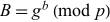 .
.
This can be done by computing  from
from  or
or  from
from 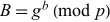 . This is the discrete
logarithm problem, which is computationally infeasible for large
. This is the discrete
logarithm problem, which is computationally infeasible for large  . Computing the discrete logarithm of a number modulo
  takes roughly the same amount of time as factoring the product of two primes the
same size as
takes roughly the same amount of time as factoring the product of two primes the
same size as  ,
which is what the security of the RSA cryptosystem relies on. Thus, the Diffie-Hellman
protocol is roughly as secure as RSA.
,
which is what the security of the RSA cryptosystem relies on. Thus, the Diffie-Hellman
protocol is roughly as secure as RSA.
