


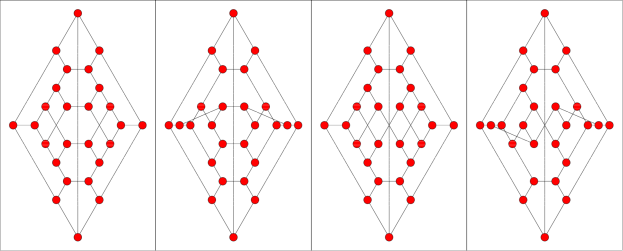
The dice graphs are the four 26-vertex, 39-edge cubic Hamiltonian graphs illustrated above. They were defined as Dice(1), Dice(2), Dice(3), and Dice(4) by Robertson et al. (2019) in their study of excluded minors in cubic graphs. All four have girth 5, graph diameter 5, and chromatic number 3. Dice(1) and Dice(2) have graph crossing number 2, while Dice(3) and Dice(4) have graph crossing number 3.
The name appears to be a play on "die-connected", the class of graphs for which the four dice graphs occur as forbidden topological minors.
A cubic graph is cyclically 5-connected if it has girth at least 5 and every edge cut that separates two subgraphs containing cycles has at least five edges. Such a graph is dodecahedrally-connected if no 5-edge cut having at least seven vertices on each side cuts off a subgraph that can be drawn in a disk with its five attachment vertices on the boundary. A dodecahedrally-connected graph having at least six edges in every edge cut with at least nine vertices on each side is termed die-connected (Robertson et al. 2019).
The corresponding characterization states that a die-connected graph is apex iff it contains none of the Petersen graph, jaws graph, starfish graph, log graph, antilog graph, and four dice graphs as topological minors; the dice graphs therefore account for four of the nine obstructions (Robertson et al. 2019).
Precomputed properties of the dice graphs are available in the Wolfram Language using GraphData[ "Dice", n
 ] for
] for  , 2, 3, and 4.
