


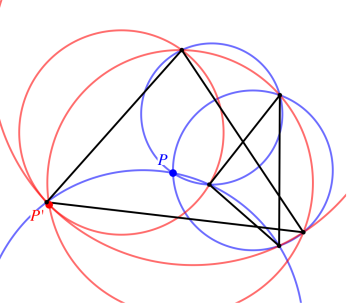
Two nondegenerate triangles  and
and  are cyclologic if the three circles
through
are cyclologic if the three circles
through  ,
,
 ,
and
,
and  are concurrent. In this case, the circles
through
are concurrent. In this case, the circles
through  ,
,
 ,
and
,
and  are also concurrent, and conversely. The two points
of concurrence are called the cyclologic centers
of the triangles (Rabinowitz and Suppa 2026, p. 105).
In the illustration above, the first point of concurrence
is denoted
are also concurrent, and conversely. The two points
of concurrence are called the cyclologic centers
of the triangles (Rabinowitz and Suppa 2026, p. 105).
In the illustration above, the first point of concurrence
is denoted  and the reciprocal point is denoted
  .
.
Let  be any point inside
  . For
. For  equal to 13, 14, 15, or 16, let
  ,
,  , and
, and  be the Kimberling centers
  of
of  ,
,  , and
, and  , respectively. Then
  and
and  are cyclologic (Rabinowitz and Suppa 2026). The
four choices are the first Fermat point
are cyclologic (Rabinowitz and Suppa 2026). The
four choices are the first Fermat point  , second
Fermat point
, second
Fermat point  ,
first isodynamic point
,
first isodynamic point  , and second isodynamic
point
, and second isodynamic
point  ,
respectively.
,
respectively.
For  ,
an inversion centered at
,
an inversion centered at  maps the three configurations to equilateral
triangles erected outwardly on the sides of the inverse
of
maps the three configurations to equilateral
triangles erected outwardly on the sides of the inverse
of  .
Their circumcircles are concurrent at the first
Fermat point by Napoleon's theorem. Applying
the inversion again gives three concurrent circles
through
.
Their circumcircles are concurrent at the first
Fermat point by Napoleon's theorem. Applying
the inversion again gives three concurrent circles
through  ,
,
 ,
and
,
and  .
The assumption that
.
The assumption that  is in the interior is essential
to the outward-orientation step: each first
isodynamic point lies inside the corresponding circumcircle,
while the opposite vertex lies outside it. Consequently,
the result for
is in the interior is essential
to the outward-orientation step: each first
isodynamic point lies inside the corresponding circumcircle,
while the opposite vertex lies outside it. Consequently,
the result for  can fail when
  lies outside
  .
For
.
For  ,
the analogous inversion gives equilateral
triangles erected inwardly, and their circumcircles
concur at the second Fermat point.
,
the analogous inversion gives equilateral
triangles erected inwardly, and their circumcircles
concur at the second Fermat point.
