

Cronbach's alpha, also called coefficient alpha, is a statistic used to measure the internal consistency of a collection of test or questionnaire items. For  items, let
  be the score recorded for item
  and let
  be the composite total score. Writing
  and
and  for the corresponding variances,
Cronbach's alpha is
for the corresponding variances,
Cronbach's alpha is
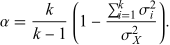 |
The coefficient increases when the items have larger positive covariances relative to their individual variances. Its value depends both on the relationships among the items and on the number of items, so a high value alone does not establish that all items measure a single underlying quantity.
