

A covering system is a finite collection of congruences  with
 whose residue classes together contain every integer.
It is distinct when its moduli
 are pairwise different (Erdős 1950). A complete
residue system for a single modulus gives a covering, but its moduli repeat.
Filaseta et al. (2026) proved that a distinct covering system with smallest modulus a prime  satisfies
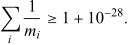 |
Filaseta et al. (2026) also proved that there is no covering system with distinct moduli that are all multiples of such a prime. Filaseta et al. (2026) also proved that at most nine distinct covering systems can have pairwise disjoint sets of moduli.
Dai et al. (2026) proved that every distinct covering system has smallest modulus less than 14000. If all moduli are squarefree, some modulus is at most 7. If a distinct covering system has only odd moduli, its smallest modulus is at most 9 and the least common multiple of its moduli is divisible by 45. These last two conclusions are necessary conditions and do not establish that an all-odd distinct covering system exists. The proof uses finite computations with directed rounding and exact rational inequalities (Dai et al. 2026).

 and Some Related Problems." Summa Brasil. Math. 2,
113-123, 1950.Filaseta, M.; Kalogirou, A.; and Klein, J. "Results
for Distinct Covering Systems with a Prime Minimum Modulus
 ." 15 Nov 2026.