


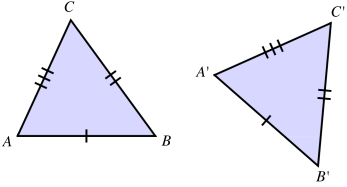
Congruent triangles are triangles for which a rigid motion maps one triangle onto the other with corresponding vertices matched. Equivalently, corresponding side lengths and corresponding angle measures are equal. Thus congruence records equality of both size and shape, whereas similar triangles record only equality of shape (Coxeter and Greitzer 1967).
Two triangles are congruent if their corresponding data satisfy any of the side-side-side, side-angle-side, angle-side-angle, or angle-angle-side criteria. For right triangles, equality of the hypotenuse and one corresponding leg is also sufficient. The required rigid motion is a composition of translations, rotations, and reflections.
The four general criteria use three pieces of corresponding data. The SSS theorem uses three side lengths, the SAS theorem uses two sides and their included angle, the ASA theorem uses two angles and their included side, and the AAS theorem uses two angles and a nonincluded side. Equality of all three corresponding angles proves only that the triangles are similar triangles, not that they are congruent. In general, equality of two sides and a nonincluded angle also does not prove congruence.
