


A congruent number can be defined as an integer that is equal to the area of a rational right triangle (Koblitz 1993).
For a positive integer  , the associated elliptic
curve is
 |
(1)
|
which is a quadratic twist of  . The integer
 is a congruent number iff
 has a rational
point of infinite order. Equivalently,
 has elliptic curve rank
at least 1 over
 (Koblitz 1993, Watkins et al. 2014).
Watkins et al. (2014) reported that the smallest known parameter producing elliptic curve rank 7 is  and listed 27 such elliptic
curves. Their extensive searches found no elliptic
curve in this family with elliptic
curve rank 8. They also described a heuristic suggesting
that 7 might be the maximal elliptic curve rank
in this family, although whether the elliptic
curve ranks in the family are bounded
remains unknown.
Jaswal (2026) reports a paired rank-one construction. Let  and
 be relatively prime squarefree integers with
 , each a quadratic
residue modulo every prime number dividing the
other. Then there is a positive squarefree integer
 such that
 and
 both have elliptic
curve rank one. Their Hasse-Weil L-functions
have a zero of multiplicity
one at
 , and each curve has a rational
point of infinite order whose
 -coordinate belongs to
 . In particular,
 and
 are congruent numbers. The claimed proof,
produced using author-directed Claude Opus 5.5, is used in the proposed resolution
of Hilbert's tenth problem. The reported
AI and finite computational checks do not constitute independent specialist verification.
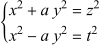
Numbers  such that
 |
(2)
|
are also known as congruent numbers. They are a generalization of the congruum problem, which is the case  .
For example,  , the smallest congruent numbers are
 |  |  |
(3)
|
 |  |  |
(4)
|
 |  |  |
(5)
|
 |  |  |
(6)
|

 Is Diophantine in
 Through Congruent-Number Twists." Version 3. Nov. 13,
2026.