

The composite trapezoidal rule approximates a definite integral by applying the trapezoidal rule
on each of  equal subintervals. For
  and
and  , it is
![int_a^bf(x)dx approx h[(f(x_0)+f(x_n))/2+sum_(j=1)^(n-1)f(x_j)].](/images/equations/CompositeTrapezoidalRule/NumberedEquation1.svg) |
If  has a continuous second derivative, then for some
 the error is
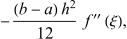 |
where the error means the exact integral minus its approximation. Thus the method has error  as
as  . In big-O notation,
this means that the error magnitude is bounded by a constant multiple of
. In big-O notation,
this means that the error magnitude is bounded by a constant multiple of  for all sufficiently small positive
  .
.
