

Colombo's determinant problem asks when the matrix  with entries
 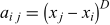 has nonzero determinant
for distinct real numbers
has nonzero determinant
for distinct real numbers  ,
,  , ...,
  and a positive integer
  .
The proposed characterization, attributed to Colombo's work by Ma (2026), is the
following for
.
The proposed characterization, attributed to Colombo's work by Ma (2026), is the
following for  .
.
The determinant is nonzero iff  and either
  or
or  is even.
Two obstructions explain the necessary conditions. Expanding the powers gives matrix rank at most  , so
, so  forces singularity. If
  is odd, the matrix is skew symmetric and therefore has zero
determinant when
is odd, the matrix is skew symmetric and therefore has zero
determinant when  is odd. For
  , its determinant is
  and never vanishes.
Ma (2026) reported a proof of the remaining case, even  and odd
  ,
together with a Lean formalization. The even-exponent case follows from earlier results
discussed in that paper. The proof was developed with AI
assistance, and Li et al. (2026) supplied an independent proof.
Journal publication of these reports had not been confirmed as of Sep. 7, 2026.
,
together with a Lean formalization. The even-exponent case follows from earlier results
discussed in that paper. The proof was developed with AI
assistance, and Li et al. (2026) supplied an independent proof.
Journal publication of these reports had not been confirmed as of Sep. 7, 2026.
