

The class group of a number field  is the Abelian multiplicative
group formed by the equivalence classes
of its nonzero fractional
ideals. Each nonzero fractional
ideal
is the Abelian multiplicative
group formed by the equivalence classes
of its nonzero fractional
ideals. Each nonzero fractional
ideal  of
of  belongs to an equivalence
class
belongs to an equivalence
class ![[I]](/images/equations/ClassGroup/Inline4.svg) consisting of all fractional ideals
consisting of all fractional ideals  satisfying
  for some nonzero element
  of
of  . The number of equivalence
classes of nonzero fractional
ideals of
. The number of equivalence
classes of nonzero fractional
ideals of  is a finite number, known as the class
number of
is a finite number, known as the class
number of  .
For
.
For 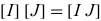 , multiplication
of equivalence classes of fractional
ideals is defined in the obvious way, i.e., by letting
, multiplication
of equivalence classes of fractional
ideals is defined in the obvious way, i.e., by letting ![[I][J]=[IJ]](/images/equations/ClassGroup/Inline12.svg) .
.
Writing the class group as  ,
its 2-torsion subgroup
is
,
its 2-torsion subgroup
is ![Cl(K)[2]={c in Cl(K):c^2=1}](/images/equations/ClassGroup/Inline14.svg) , where 1
denotes the identity element. This is a vector
space over the finite field
, where 1
denotes the identity element. This is a vector
space over the finite field  . Its dimension
![g_2(K)=dim_(F_2)Cl(K)[2]](/images/equations/ClassGroup/NumberedEquation1.svg) |
is called the 2-rank of the class group. In particular, ![|Cl(K)[2]|=2^(g_2(K))](/images/equations/ClassGroup/Inline16.svg) .
.
Elkies and Klagsbrun (2026) announced a totally real cubic field with class-group 2-rank at least
25 and a complex cubic field with class-group 2-rank
at least 26. These were reported as the largest known lower
bounds for the two respective types (Elkies 2026; ICARM, curves 404 and 403).
The associated elliptic curves have ranks
at least 27 and 28, respectively. For each elliptic
curve, the cubic field is generated by the  -coordinate
of a nonidentity 2-torsion point. Brumer and Kramer
(1977, Prop. 7.1) bound the elliptic curve
rank from above using the class-group 2-rank together with local reduction data.
Thus the elliptic curve rank computations and
local reduction data give the stated lower bounds
for the class-group 2-ranks; they do not assert that the class-group 2-ranks are
exactly 25 and 26.
-coordinate
of a nonidentity 2-torsion point. Brumer and Kramer
(1977, Prop. 7.1) bound the elliptic curve
rank from above using the class-group 2-rank together with local reduction data.
Thus the elliptic curve rank computations and
local reduction data give the stated lower bounds
for the class-group 2-ranks; they do not assert that the class-group 2-ranks are
exactly 25 and 26.

 and
and  Records for Elliptic Curves
  of Ranks 27-30; Record 2-Ranks 25 (Real) and 26 (Complex)
for Class Groups of Cubic Fields." Number Theory List, Aug. 29, 2026.
of Ranks 27-30; Record 2-Ranks 25 (Real) and 26 (Complex)
for Class Groups of Cubic Fields." Number Theory List, Aug. 29, 2026.