


"Casting out nines" is an elementary check of a multiplication which makes use of the congruence  (mod 9). Let decimal numbers
be written
(mod 9). Let decimal numbers
be written  ,
,
 , and their product
be
, and their product
be  .
Let the digit sums of these numbers be
.
Let the digit sums of these numbers be  ,
,  , and
, and  . Then
 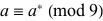 ,
, 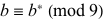 , and
, and 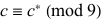 . Furthermore
  , so
, so 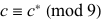 . So if
  and
and  are incongruent (mod 9), the multiplication
has been done incorrectly.
are incongruent (mod 9), the multiplication
has been done incorrectly.
Casting out nines is also an addition test, since  , and a subtraction
test, since
, and a subtraction
test, since  .
It can also be used as a division test for
.
It can also be used as a division test for  (i.e.,
  ) since
 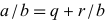 .
.
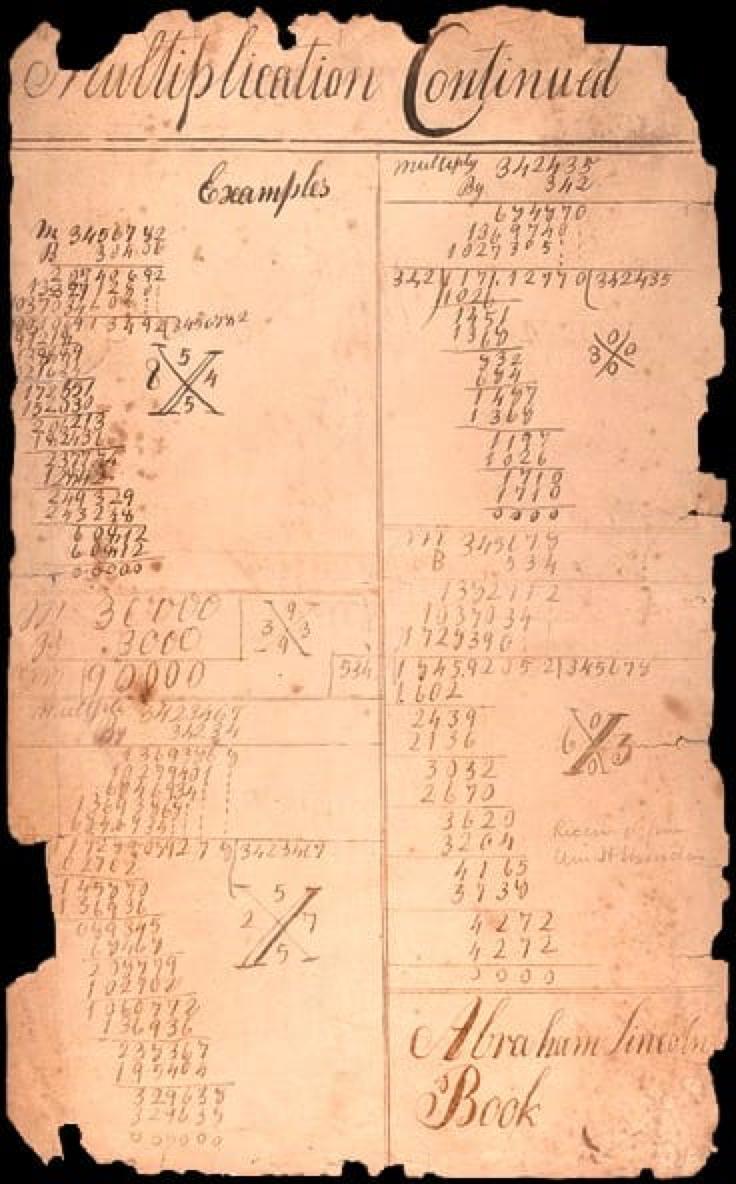
In 1824, Abraham Lincoln used casting out nines to check long multiplication in his cyphering book, a page of which is illustrated above (History of Mathematics Project).
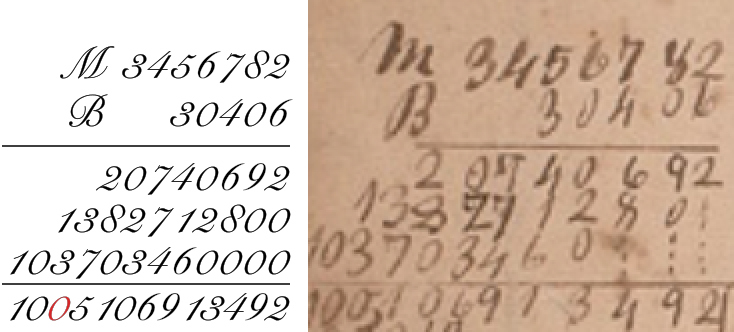
The first exercise in the left column of the page is the multiplication  , shown above in a
modern transcription beside the corresponding manuscript detail. Lincoln correctly
wrote the three nonzero intermediate products 20740692,
1382712800, and 103703460000. Their sum, the correct product,
is 105106913492, but his final handwritten line instead reads 1005106913492. The
extra zero before the 5 is highlighted in red in the transcription.
, shown above in a
modern transcription beside the corresponding manuscript detail. Lincoln correctly
wrote the three nonzero intermediate products 20740692,
1382712800, and 103703460000. Their sum, the correct product,
is 105106913492, but his final handwritten line instead reads 1005106913492. The
extra zero before the 5 is highlighted in red in the transcription.
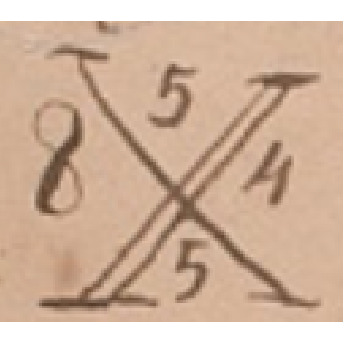
The cross is a compact layout for the check: the residues of the multiplier and multiplicand are written at left and right, the residue of their product at the bottom, and the residue of the written answer at the top. Agreement of the top and bottom entries means that the multiplication passes the test.
Lincoln placed 8 at the left of the cross because the digit sum of 3456782 is 35, which is congruent to 8 modulo 9. Similarly, the digit
sum of 30406 is 13, giving the 4 at the right. Multiplying these two residues
gives  ,
so 5 appears at the bottom. Lincoln's written result 1005106913492 also has digit
sum 41, which is congruent to 5 modulo 9, giving the matching number at the top.
,
so 5 appears at the bottom. Lincoln's written result 1005106913492 also has digit
sum 41, which is congruent to 5 modulo 9, giving the matching number at the top.
Because the check compares only residues modulo 9, it does not detect errors that preserve the digit sum, including a transposition of digits or the insertion of a zero. The extra zero in Lincoln's written addition is such an error, so the check did not reveal it. The manuscript leaf is now held by Columbia University's Rare Book & Manuscript Library in New York as Plimpton 089.001 (Columbia University Libraries).
Casting out nines was transmitted to Europe by the Arabs, but was probably developed somewhere on the Indian subcontinent and is therefore sometimes also called "the Hindu check," with "Hindu" simply meaning the people of the Indian subcontinent. The method of checking arithmetic by casting out nines was described by Fibonacci in his Liber Abaci (Wells 1986, p. 74).
