


The butterfly catastrophe curve is the plane curve with parametric equations
 |  | 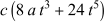 |
(1)
|
 |  |  |
(2)
|
where  and
 are real numbers with
 and
 ranges over the real numbers
(von Seggern 1993, p. 94). The smallest algebraic
curve containing this parametrized locus has degree
5. Its implicit equation therefore defines a quintic
curve; its real points can also include isolated points not traced by real
 .
It is a two-control-parameter section of the butterfly catastrophe. For fixed  and
 ,
consider the potential
 .
The curve consists of the parameter pairs
 for which
 has a degenerate critical
point, meaning that
 for some real
 . Solving these two conditions for
 and
 gives the displayed parametric
equations. The curve is therefore a planar discriminant section, rather than
the full four-control-parameter butterfly catastrophe.
